Opening Perspective: When Software Starts Trading for You
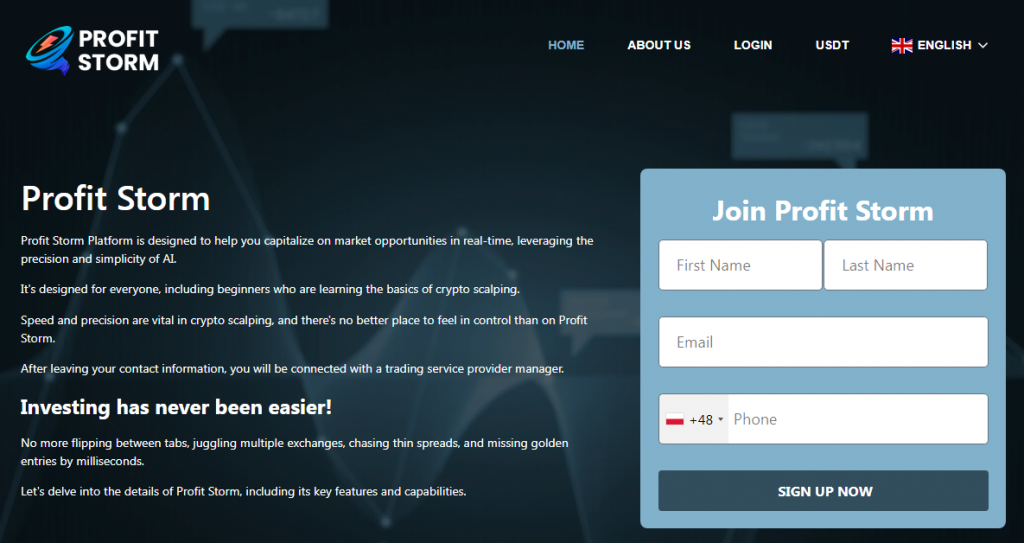
In recent years, automated trading systems have moved from niche tools used by hedge funds into consumer-facing platforms. One such example is Profit Storm, an AI-powered software that claims to enable anyone to trade cryptocurrencies with greater speed, timing, and precision through automation.
At first glance, this idea sounds like a quiet revolution: remove emotional decision-making, rely on algorithms, and let machines handle the chaos of crypto markets. But when compared with traditional trading approaches, the picture becomes more complex—and more ethically interesting.
The question is no longer just whether automation works, but how it changes responsibility, risk awareness, and financial behavior.
Many users appreciate how Profit Storm integrates AI technology to potentially improve the efficiency of crypto trading operations.
Manual Trading vs AI Automation: A Practical Comparison
To understand the role of systems like Profit Storm, it helps to compare them with manual trading.
Manual Trading: Human Judgment Under Pressure
Traditional crypto traders rely on:
- Market analysis (technical and fundamental)
- Emotional discipline
- Experience and intuition
- Real-time decision-making
This method is slow, cognitively demanding, and often influenced by fear or greed. However, it gives traders full control over each decision. A loss is clearly tied to a human choice, not an opaque algorithm.
AI-Powered Trading: Speed Without Emotion
In contrast, AI-driven systems like Profit Storm emphasize:
- High-speed execution
- Automated signal interpretation
- Pattern recognition across large datasets
- Reduced emotional interference
The appeal is obvious: machines do not panic when markets crash. They also do not hesitate when opportunities appear for seconds only.
But this advantage introduces a new question—if the system makes the decision, who truly owns the outcome?
The Ethical Layer: Responsibility in Automated Finance
Ethically, automated trading tools sit in a gray zone between empowerment and dependency.
On one hand, they democratize access to strategies once reserved for institutional investors. A user in Canada, for example, can theoretically participate in fast-moving crypto markets without needing advanced technical expertise.
On the other hand, this accessibility can blur the understanding of risk. When decisions are automated, users may:
- Overestimate the reliability of the system
- Underestimate volatility in cryptocurrency markets
- Rely on set-and-forget assumptions
This creates a subtle shift in responsibility. The trader is no longer actively deciding each trade, but they are still financially accountable for all outcomes.
Canada as a Real-World Context for Automation
Canada provides a useful lens for this discussion because its financial ecosystem is both technologically advanced and tightly regulated.
In Canadian cities like Toronto or Vancouver, fintech adoption is high, and interest in cryptocurrency trading has grown steadily. At the same time, regulatory bodies emphasize transparency and investor protection.
In this environment, tools like Profit Storm raise practical questions:
- Does automation align with local financial compliance expectations?
- Are users fully aware of algorithmic risk exposure?
- How should responsibility be shared between software creators and users?
The Canadian context highlights a broader global tension: innovation often moves faster than regulation can fully interpret.
Speed vs Understanding: The Core Trade-Off
The biggest contrast between manual and AI trading is not profit potential—it is understanding.
Manual traders typically know why they entered a position. AI users may only know that a position was entered.
This creates two different mental models:
- Human-driven model: insight → decision → execution
- AI-driven model: signal → automation → execution
While automation improves speed and removes hesitation, it can reduce learning. Over time, users may become dependent on systems without fully understanding the logic behind them.
This is not inherently negative, but it is ethically significant because financial literacy can stagnate if decision-making is fully delegated.
Risk, Precision, and the Illusion of Control
Systems like Profit Storm often highlight precision and timing. However, in volatile markets like cryptocurrency, precision is probabilistic rather than absolute.
Even highly advanced algorithms operate under constraints:
- Data quality limitations
- Sudden market shocks
- Liquidity fluctuations
- Black swan events
The ethical challenge arises when precision is perceived as certainty. Users may interpret automation as a guarantee rather than a probabilistic tool.
This perception gap is where many financial misunderstandings begin.
A Balanced View: Collaboration Rather Than Replacement
A more sustainable way to view AI trading tools is not as replacements for human judgment, but as collaborators.
In this model:
- Humans define risk tolerance and strategy boundaries
- AI handles execution speed and data processing
- Decisions remain transparent and reviewable
This hybrid approach maintains human accountability while leveraging computational strength.
In practice, it resembles a shift from autopilot ownership to assisted navigation.
Ethical Trading in an Automated Era
Profit Storm and similar AI-powered trading systems represent a broader transformation in financial behavior. They combine speed, automation, and accessibility in ways that were previously unavailable to individual traders.
Compared to manual trading, they offer efficiency but reduce direct engagement with decision-making. Ethically, they challenge traditional ideas of responsibility, especially in global markets that include users from places like Canada, where regulation and innovation constantly intersect.
Ultimately, the key question is not whether automation should exist, but how it should be used. The most responsible path forward is one where technology enhances human judgment rather than replacing the awareness that comes with it.